
A Citywide Tour of Cards, Games, and MTG in NYC
Stories about cards, games, and especially the card game Magic: The Gathering in New York City, along with 6 sites that play a role
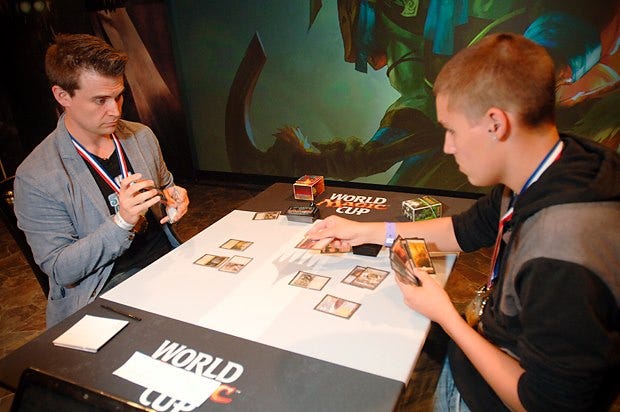
_vs_Daniel_Antoniou_(Cyprus).jpg)
To start, this post is admittedly niche, similar to a post I wrote in 2023 on the history of skateboarding in NYC.
A feature of this Substack platform is that this post will be both an email and a webpage. So to the email subscribers: If the history of cards, games, and specifically the strategy card game Magic: The Gathering vis à vis New York City is in fact of interest to you—and I say that closing my eyes, wincing, and looking away—you will have to view this as a webpage to see the whole thing.
For those daring to proceed, I have loosely organized this article around sites that could theoretically be turned into a citywide tour. Fair warning: This tour is probably better read than traveled. Doing so would require hours on the subway, hundreds of dollars in taxis, and/or over a half marathon of walking:
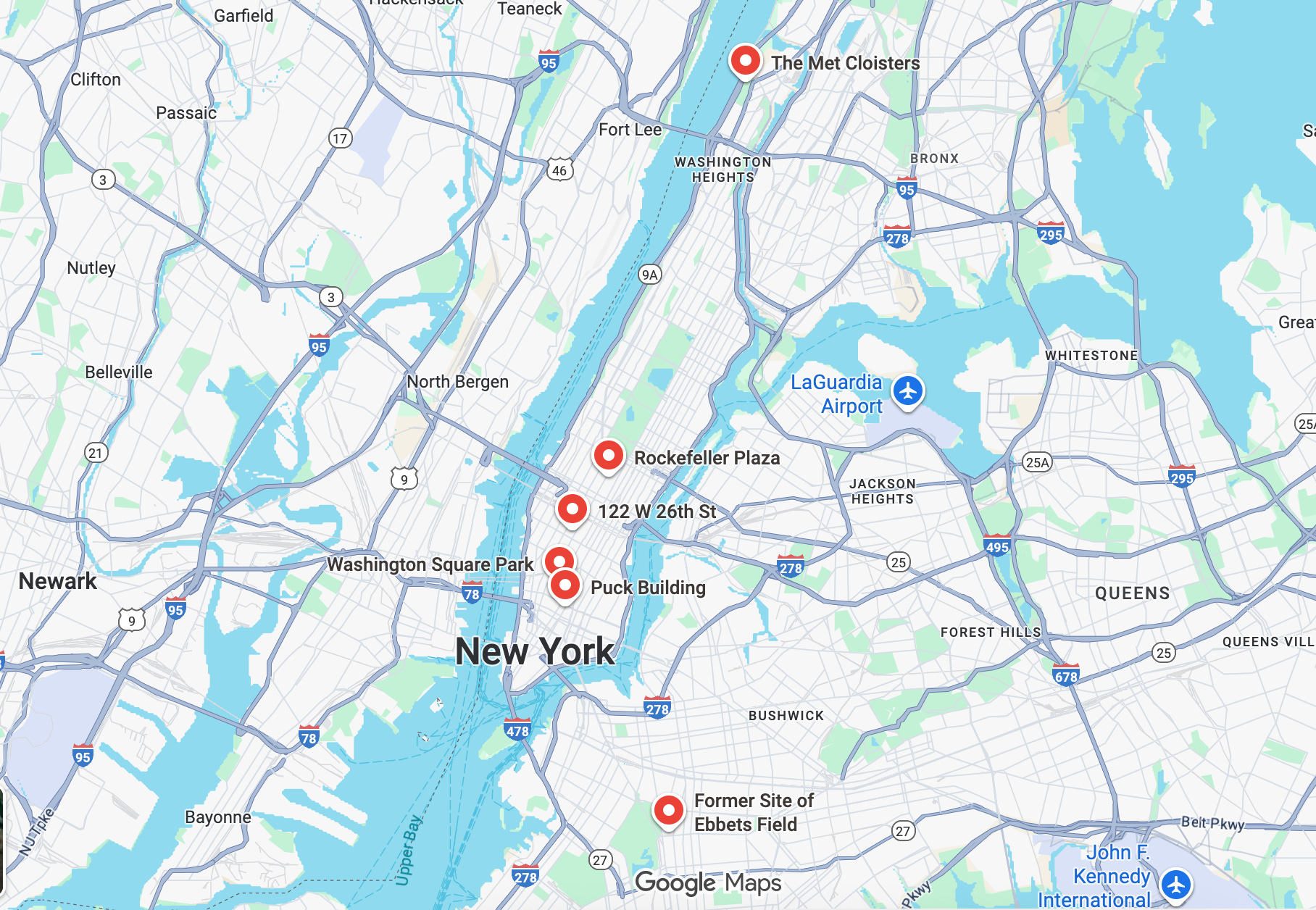
As the map shows, a few of them could reasonably be covered in one day. Site 1: Washington Square Park and Site 6: 30 Rock might be the best bang-for-your-buck spots for tourists to check out in general, with this article adding some context. Site 2: The Met Cloisters is the best option for pairing with a museum visit, and Site 3: Ebbets Field is a pilgrimage for sports fans to consider. (I recommend the stretch of Franklin Avenue between Eastern Parkway and Atlantic Avenue for some stellar food options afterward.) For Magic players truly looking to see places of historical interest to the game, I’d stick with Site 4: Neutral Ground and Site 5: Puck Building, both of which have plenty of places to shop and eat nearby. No matter your goals, in assembling these sites, I share some of the stories of cards, games, and especially the trading card game Magic: The Gathering within the city’s boundaries.
My History with Magic
One night about a year ago, I was telling my friend N. about this idea for a post I was working on about the history of NYC and Magic. “Tell them about your own history,” he said. He should know; he was there.
A hobby is never just about the hobby. Even the most insular of activities are defined too by the community surrounding them. My personal experience playing Magic started when I was a kid and then returned as an adult. The game at times consumed me and created both friendships and factions.
It began in elementary school with friends in the early 1990s. I had a box of cards divided by color. Our fidelity to the rules was shaky at best, but we all tried with whatever cards we owned. Even now, decades later, I’ll feel an unexpected rush of nostalgia over a specific image or design that brings me back to that era. I don’t know where any of my original cards are, and I never owned any of the cards that could nowadays be a down payment on a house.
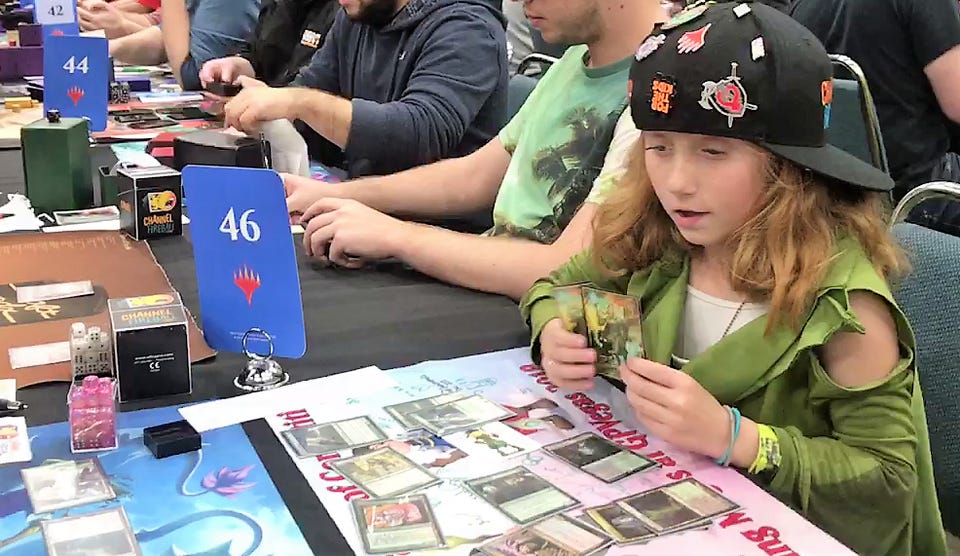

For many years I stopped playing Magic, although I continued to play other games and collect other cards. Then in 2013, on a whim, I purchased a box of Magic cards on eBay. My friend D. told me he played too, so I invited him to come over, and we spent the day building decks and battling them against each other. I felt ten again! We became Magic evangelists to friends and friends-of-friends, resulting in a playgroup of a few dozen people that miraculously persisted for years. Highlights include games in the back of a bus, on the floor of a Cape Cod beach house, and once in my apartment where K. and I agreed to read the all the evocative “flavor text” printed at the bottom of each card before playing it.
Some rivalries started in Magic battlefields but leaked into the real world, and eventually Magic gave way to other games, with different games calling different people. Nearly all of us moved, some out of the city altogether. All good things must come to an end, but it was a special time in my life with people I still cherish. Finding friends in adulthood is hard, and I had managed to make dozens over the course of a few months, thanks to a common love for Magic.
I continued to play long after the playgroup dissolved. I played in small tournaments at Twenty Sided in Williamsburg and The Uncommons in the East Village and once traveled out of state for a larger tournament. For years I kept up with nearly every set online, and only recently did I finally prune my collection down to just my favorite cards.

What Is Magic: The Gathering?
Lest I get ahead of myself, you needn’t have ever played the game to make sense of this post, at least that’s my intention. In fact, I spend some time generally going into the histories of games and cards before Magic even comes into the picture.
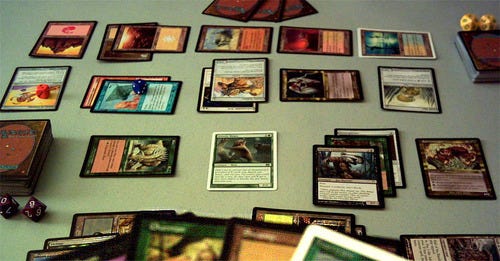
But for the neophytes, Magic is a strategy game played with cards that players buy and trade for. There are many variants and house rules, but in essence, before the game even begins, all players privately assemble a unique deck of cards from what they’ve collected. The cards are a mix of creatures that can attack opponents, spells with a variety of effects, and lands that permit players to “cast” the creatures and spells. All players start with 20 life points. They shuffle their decks, draw the top seven cards, and then take turns drawing a new card and deciding what creatures and spells to cast. Players win by knocking their opponent(s) down to 0, often accomplished by attacking with creatures.
I’ve heard Magic lumped together many times with the fantasy roleplaying game Dungeons & Dragons, so I think it’s worth making a distinction. The art printed on the cards is fantasy art, and there are writers who develop the lore behind the cards’ characters. However, unlike D&D, the game of Magic is fundamentally not a roleplaying game.
In terms of the broad gameplay mechanics and complexity, I’d say Magic is comparable to bridge or gin rummy, where players draw cards from a shuffled deck and then try to make optimal decisions based on the cards in their hand. I’ve heard the game explained as a mash-up of poker and chess. Granted, the card names are a little less “three of spades” and a little more “Phyrexian Obliterator.” Another big difference between D&D and Magic is the time investment. A game of Magic sometimes lasts just a few minutes, whereas D&D campaigns can last hours at a time and continue across years.
In terms of history, however, and not gameplay, the games are far more closely connected. In fact, the whole idea behind Magic was to have something quick that D&D players could play while waiting between games. Peter Adkison, one of Magic’s original creators, noticed that people who played in the D&D convention circuit were often hanging out in lobbies between games, and he yearned for a quick, fantasy-themed, portable game. “The nerd universe would change for all time” after Adkison heard a fateful idea from game designer Richard Garfield:
[Garfield] described a card game of dueling wizards, spells fueled by mana, and perhaps most significantly, cards that would be sold in randomized booster packs. Like baseball cards, you never knew what you might get in a given pack, and some cards would be rarer than others. . . . Adkison wrote of that moment: “This game was the single most awesome gaming idea I had heard of. . . . This wasn’t just a new game, it was a new gaming form.” (Riggs, 2002)
Magic is not the first kinda complicated game where players compete with shuffled decks of cards. The biggest innovation has to do with the cards themselves. Before Magic, cards fell into one of the two categories. Most commonly they were for playing, as in cards with suits and numbers for games like bridge or poker, or game pieces from any game with cards like Uno or Monopoly. The other category of cards were those for trading, like baseball cards or themed cards that came with packs of cigarettes or gum. These cards are close in purpose to art; all form, no function.
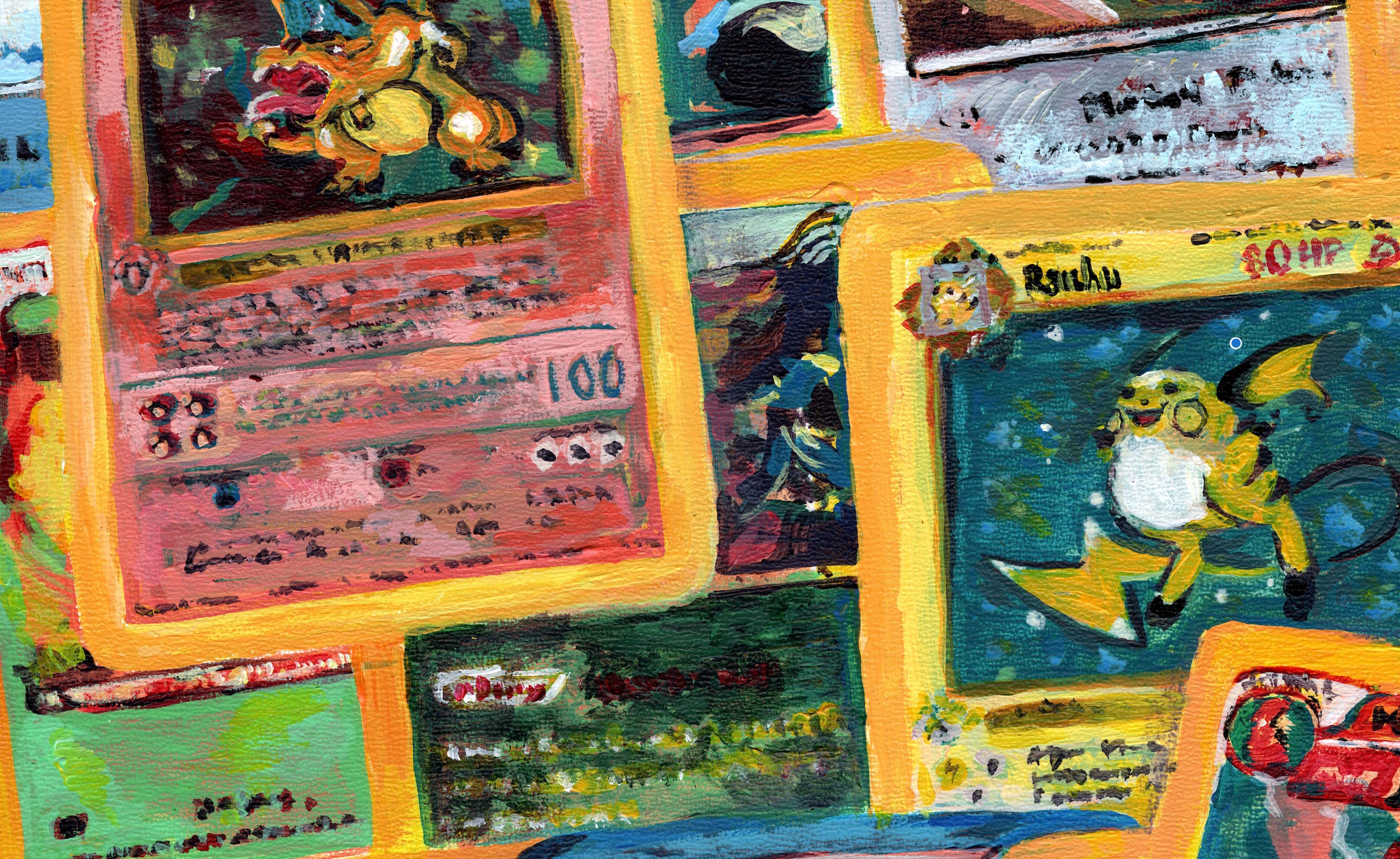
Magic is both categories. Players buy the cards in “booster packs,” which are sealed packs containing a random selection of cards from a larger set—the gaming equivalent to buying a pack of baseball cards. There is usually a chance to open a card that’s valuable in the secondary market. Players then build decks with cards they’ve opened and play games with them. Magic served as the original design behind the Pokémon Trading Card Game. Pokémon has far eclipsed Magic in popularity, but both have grown to include plenty of merchandise and are “not just a toy or a game but a universe that exists in a variety of media” (Brougère, 2004).
The hobby of Magic: The Gathering is therefore part of two lineages, really: cards and games. Both go back centuries and have long been entangled. The idea of opening cards in booster packs came later, but even that isn’t a terribly modern invention. In fact, the first booster packs were printed right here in New York City, but I’m getting ahead of myself. . . .
Site 1: Washington Square Park
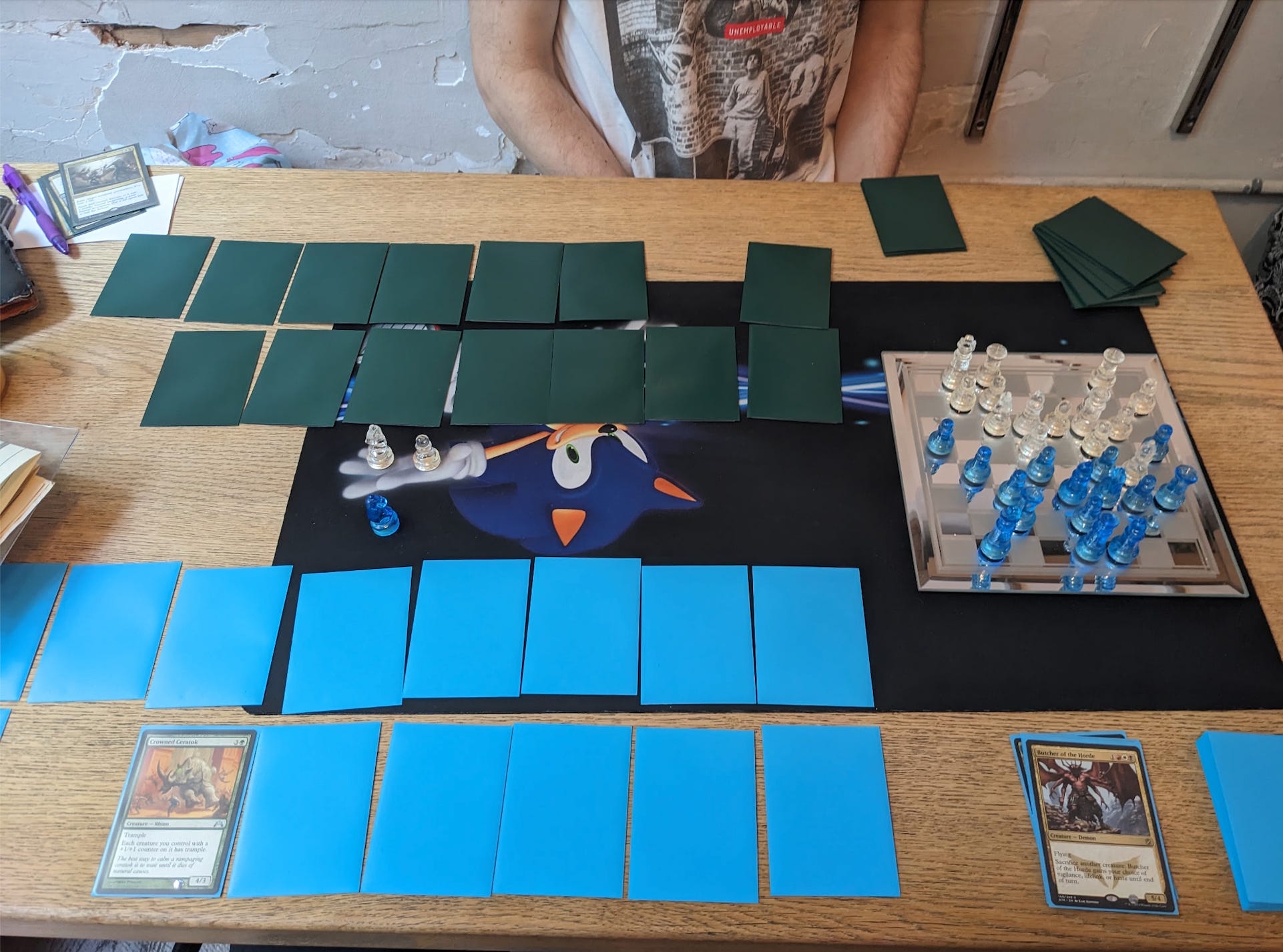
Zero in on a hobby, and at some point the history runs through the densely populated streets of New York City. One of the most noticeably played games across NYC is not a card game, but rather the centuries-old board game chess. “A strong spine of chess runs through New York City: from the Chess Forum north a few blocks to Washington Square Park, from the Marshall Chess Club in Union Square Park, where they play on old office chairs and upturned milk crates” (Roeder, 2022).
The 1993 film Searching for Bobby Fischer dramatizes the story of chess prodigy Joshua Waitzkin who grew up near the park and was fascinated by the players there. They are cutthroat and passionate about chess and inhabit one of the most famous gaming spots in the country. “The chess tables in Washington Square Park have their own musical score: click, thwack, click, thwack. . . . Bobby Fischer played here as a kid. Stanley Kubrick was a regular” (Roeder, 2022). As an adult, Waitzkin recalls the formative experience:
I grew up in New York City Downtown Manhattan. I started playing chess when I was six years old, and I discovered chess walking through Washington Square Park with my mom. And I remember watching a day or two, and then at one point I broke away from her—I was going to play on monkey bars—and I ran over and I asked an old man if I could play. And he said yes, and my mom was surprised, and we started playing. I played my first game of chess. (Huberman, 2025)
Walking into the nearby Chess Forum is to enter a time portal. It opened in the 1990s but feels like a club that’s been around for centuries. Imad Khachan, the owner of Chess Forum, hopes “that we have provided a place where, when no other place will welcome you, you have a seat” (Brass & Tyler, 2018).
Across the street is The Uncommons, “Manhattan’s first board game café” (2025), where anyone can pay by the hour to play from their expansive game library—and order a sandwich and latte while they’re at it. The Uncommons is one of the many spots around the city that sells Magic cards and hosts Magic events.
In terms of NYC gaming, chess and Magic are just the tip of the iceberg. Serious and casual players alike of backgammon, dominoes, mahjong, Scrabble, and bridge (and I’m just getting started) can all be found around the city. New York City is supremely accessible with trains, buses, hotels, airports, and meeting spaces, and the sheer volume of residents means that there is a built-in community for nearly anything. “The Statue of Liberty, the World Trade Center, and the Empire State Building were afterthoughts” to the players who commute in (Roeder, 2022). “Probabilities instead filled their heads.”
Gamers of all stripes who discover and enjoy Magic can find places around the city to play, and Wizards of the Coast, the publisher of the game, takes advantage of the many gaming and pop culture events that take place in NYC, such as announcing a recent partnership with Marvel at the annual New York Comic Con (Zupke, 2024).
Site 2: The Met Cloisters
Part of the appeal of Magic is that it is not just a game, it is also cards. Some collectors never even learn how to play, and practically no players use all of the cards they have. Thus, tracing the history of the Magic card requires reckoning with a deceptively difficult question: What is a card? I have seen all of the following sold at card trading shows (not necessarily ones devoted to Magic) and sometimes for eye-popping amounts:
Cigar wrappers
Event tickets
Custom-made cards by artists and fans
Poster-sized cards
Miniature cards
Cut-outs from other printed materials, like cereal boxes or magazines
Stamps and coins that are marketed and sold as cards
Business cards
Postcards
It’s hard to say what they all have in common. They’re mostly flat, they’re mostly small, and they mostly feature a single subject on one side. They’re mostly ephemera that often wind up in the trash. One significant similarity is that they all represent artistic expression in some way. There is, for starters, the physical design of the card. Every card is a limited-edition print with some combination of photographers, designers, and artists behind it.
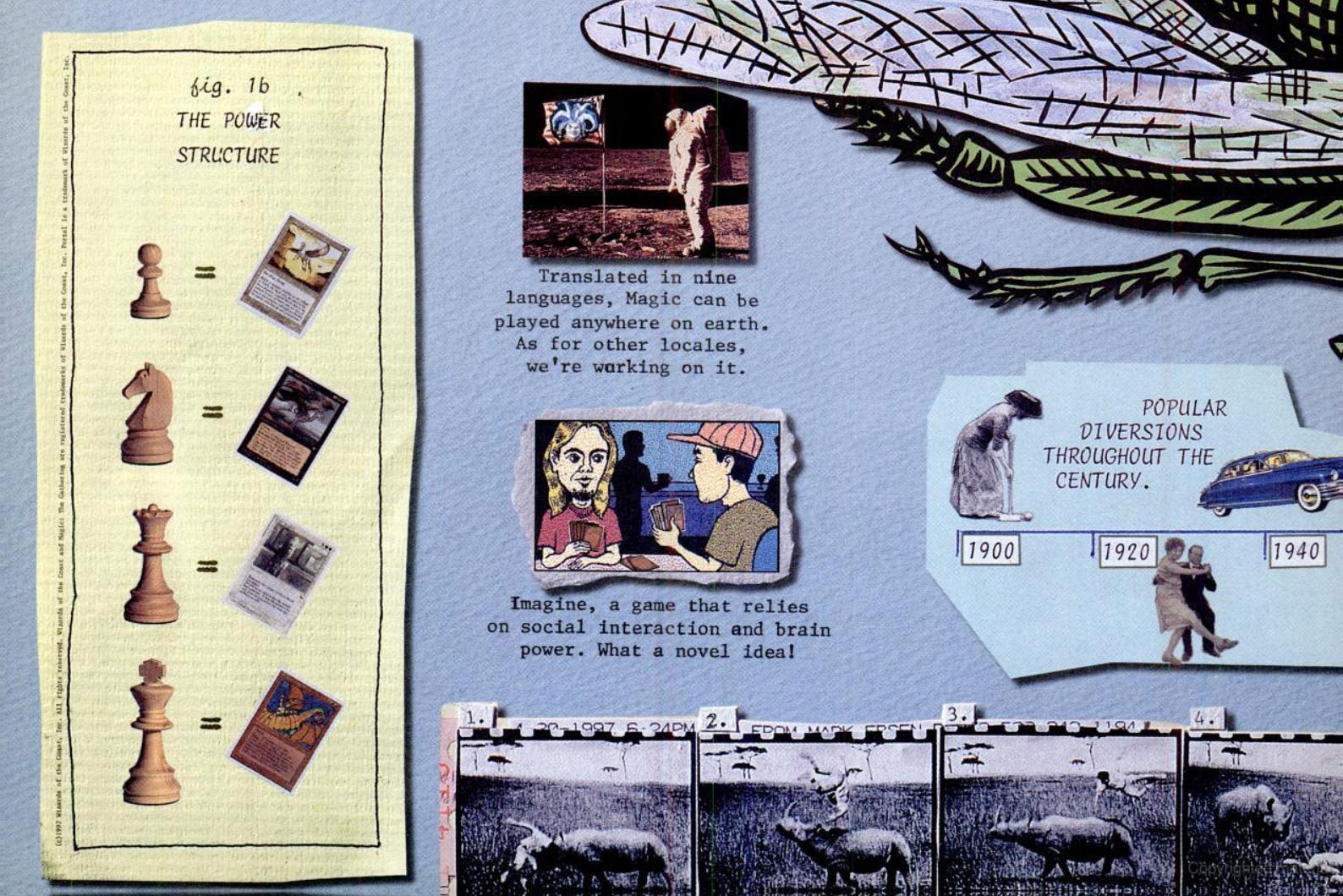
Magic took the art on each card seriously from the very first set. “The original art director for the game, Jesper Myrfors, told the artists that he wanted the images to [be] simple and iconic,” explains Magic writer Greg Fenton (2015). “He wanted them to be easily identifiable and to be able to be read from across a room.” After all, the cards are fundamentally game pieces. They are tradable, and they can be valuable, but their entire raison d’être is to be shuffled up in a deck and played with. Ideally, players can differentiate two cards as easily as a chess player can tell a pawn from a queen.
Playing cards themselves go back centuries—as far back as wooden “cards” made in ninth-century China—and can be found around the globe (Wilkinson, 1895). The Met Cloisters is a medieval art museum located in northern Manhattan, above 190th Street. There, visitors can find one of the most striking decks of playing cards on display in the city: the Cloisters Playing Cards. They are among the oldest known set of playing cards and the “only known complete deck of illuminated ordinary playing cards” from the fifteenth century (The Met, 2016).
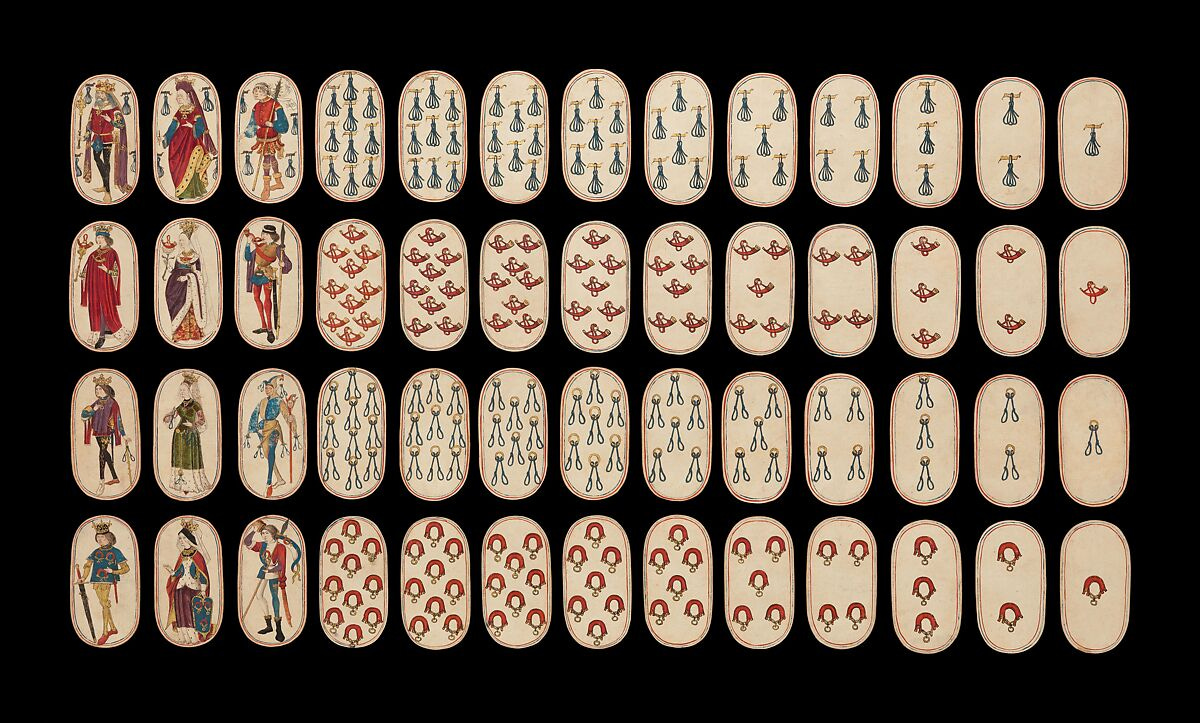
Despite the centuries between them, there are some similarities between the Cloisters cards and Magic. The hunting horns, dog collars, and images mocking court fashions at the time add flavor but aren’t central to gameplay—the same sort of aesthetic vs. gameplay balance found on Magic cards. And the fact that they are in such good condition means they were likely collected and meant to be shown off. Some modern-day Magic collectors go so far as to get their cards graded, meaning that the cards are professionally encased in airtight plastic holders with their condition assessed on the holder, making the card ideal for display but effectively unplayable.
If you travel south to the more expansive Metropolitan Museum of Art (“The Met”) on Fifth Avenue (which governs the Met Cloisters), you may also get to see some of the Jefferson R. Burdick Collection on display. Burdick was a voracious collector of baseball cards, postcards, and other ephemera, and donated his expansive collection to The Met. The collection includes thousands of artifacts of playing card history, including the famed “T206” Honus Wagner card. A copy of that early twentieth-century piece of cardboard, albeit one in better condition that The Met’s, sold in 2022 for $7.25 million (Randhawa, 2022).
Burdick’s collection includes many of the earliest examples of the trading card. Trading cards don’t contain suits or numbers; rather, they’re meant to collected, shown off, and as the name implies, traded. Much like any other artistic medium, trading cards can contain virtually any subject imaginable. In the case of Magic, the subjects are predominantly fantasy characters and settings, but across the larger genre of trading cards, sports figures are especially well represented, as exemplified by the ubiquitous baseball cards. In my opinion, this is what makes cards so incredibly collectible. Do you like a specific baseball team or soccer player? Politician? Historical era? Video game? Musician? Animal? Location? There’s a card for that. And your whole collection will fit in a shoebox.
Part of what launched the popularity of baseball in the US was Northern soldiers spreading the game to Southern states during the Civil War. When Northern soldier Andrew Peck returned to his NYC home after the war ended, he opened a sporting goods store with business partner W. Irvin Snyder and profited off the growing interest in the sport. “During the 1869 baseball season, Peck & Snyder produced a small advertising card, measuring just three-and-a-quarter inches by four-and-a-half inches and bearing a glue-mounted photograph depicting the ten members of the first explicitly professional baseball team—the Red Stocking Base Ball Club of Cincinnati” (Jamieson, 2010). These cards were sold in their store at 124–128 Nassau Street in the Financial District, a location currently split between Pace University and a doggy daycare.
These Peck & Snyder cards are generally considered the first true baseball cards and were followed by trading cards featuring not only baseball players but also actors, boxers, politicians—even playing cards. These cards came with packs of cigarettes (and later, gum) and advertised the brand on the back. In the decades that followed, many trading cards were printed around the country, generally designed simply and advertising the cigarette or gum they came with.
Site 3: Ebbets Field
The era of the modern baseball card began in NYC as well and can be traced to 1950s Brooklyn. Sy Berger was an employee of the Brooklyn-based candy company Topps. While working there, Berger “conceived the prototype for the modern baseball card, supplanting the unimaginative, smallish and often black-and-white offerings of the existing card companies” (Goldstein, 2014). With his vision, cards became flashier. Pop art, even.
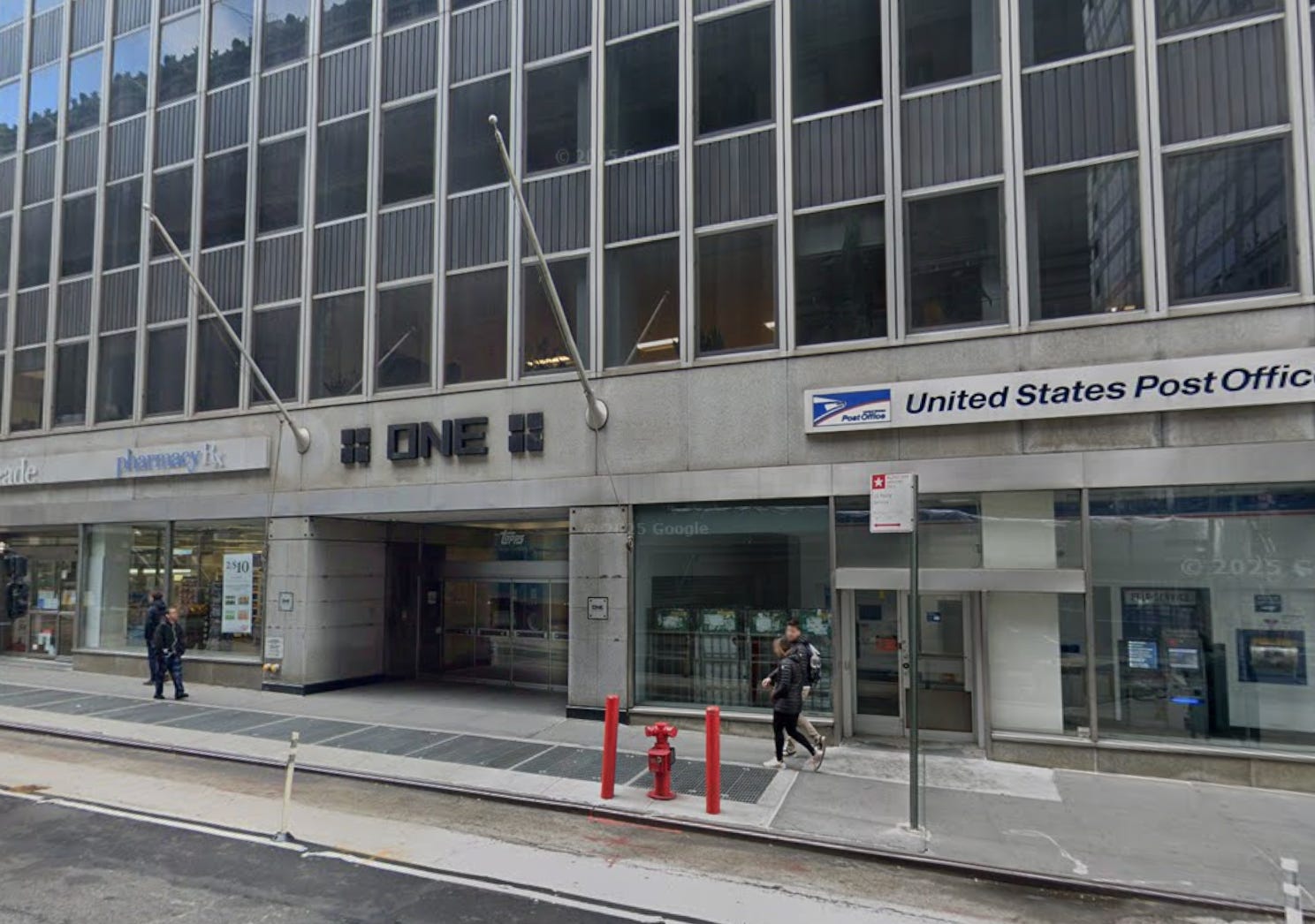
The kinds of cards originating from Peck & Snyder were little bonuses inside packages of cigarettes or gum. The modern era is when the roles reversed, and gum became the occasional added bonus inside a pack of cards. As of this writing, Topps—now a cards and collectibles company and no longer a candy company—continues to operate out of New York City, having relocated its headquarters in 1994 from Industry City in Brooklyn to One Whitehall Street in Lower Manhattan.
As Berger was rethinking the baseball card, New York Yankees center fielder Mickey Mantle was beginning his career. The first set of Topps baseball cards was released in 1951, and mint condition copies of Mantle’s iconic 1952 Topps rookie card have, like the older Honus Wagner card, sold for millions of dollars. It is “the most important baseball card in the entire industry,” according to sports card company PSA (2025). “The card is more pop culture art than mere baseball card at this point.”
The collecting world is vast, and there is plenty of overlap between baseball card collectors and Magic card collectors. Over the years, Magic card designs have taken cues from the heavily collected sports card world. Early in Magic’s development, cards were printed in standard and iridescent foil printings. More recently, Magic cards have been printed with alternate art, 3-D effects, cross-brand collaborations, and serialized short print runs, all with precedent in baseball cards.
In terms of seeing some of this history in person, there are places in every borough that play a part in the history of sports cards, including Topps’ headquarters—both its former location at 237 37th Street in Brooklyn and its current Manhattan one—or either of the city’s Major League Baseball Stadiums, Citi Field in Queens for the Mets or Yankee Stadium in the Bronx for the Yankees. If you wanted to see where Mickey Mantle played in the 1950s, you would need to visit where the original Yankee Stadium used to be before it was demolished in 2010, now Heritage Field a block south of the current stadium.
In terms of prestige, whatever your feelings on the New York Yankees (and I am a proud fan of their division rival the Baltimore Orioles), they are a behemoth in the world of baseball and by far the most valuable team in the league. The second most valuable team right now is the Los Angeles Dodgers, which have their origins in NYC, too. They were founded in Brooklyn in 1883 and stayed there until 1958.
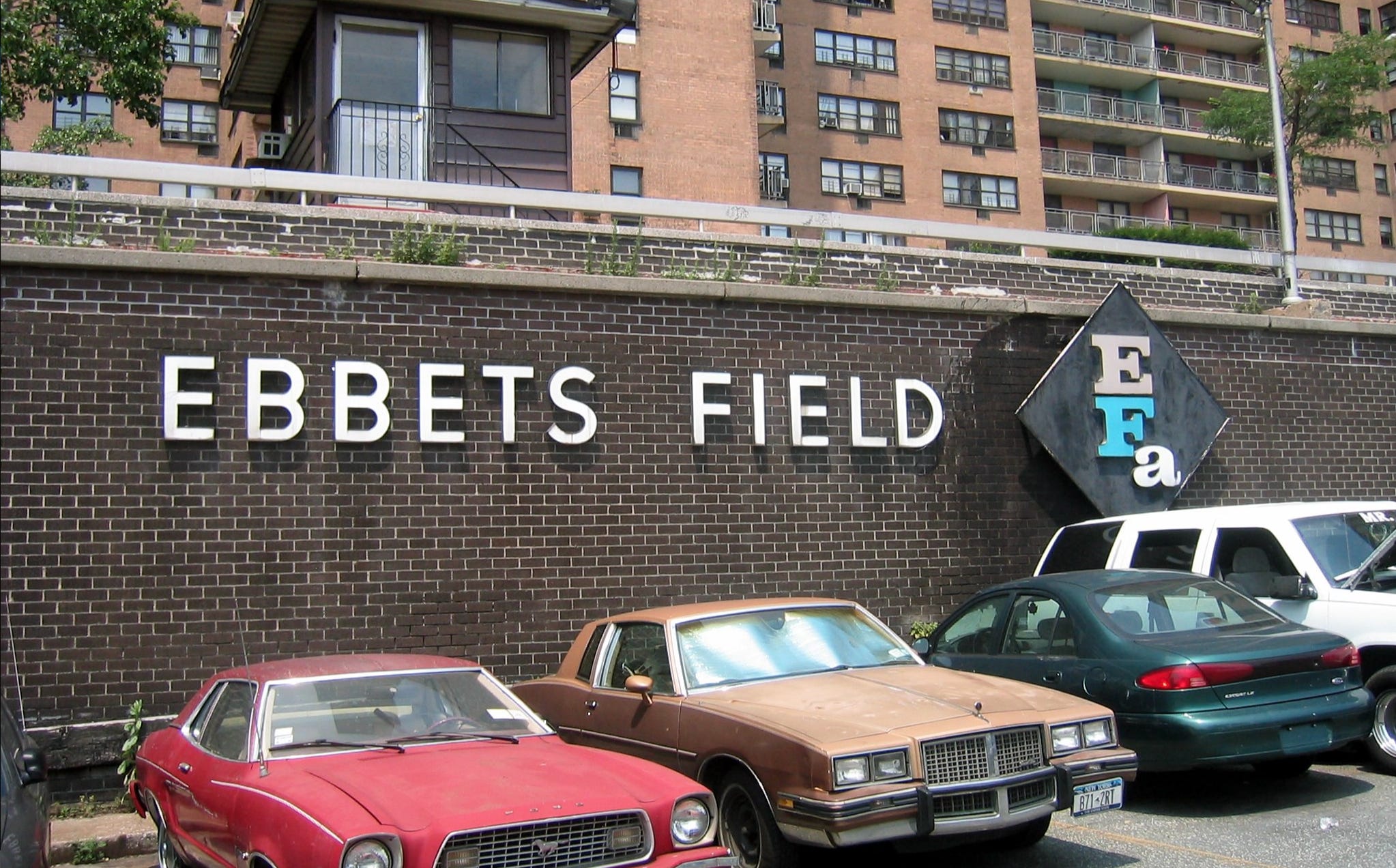
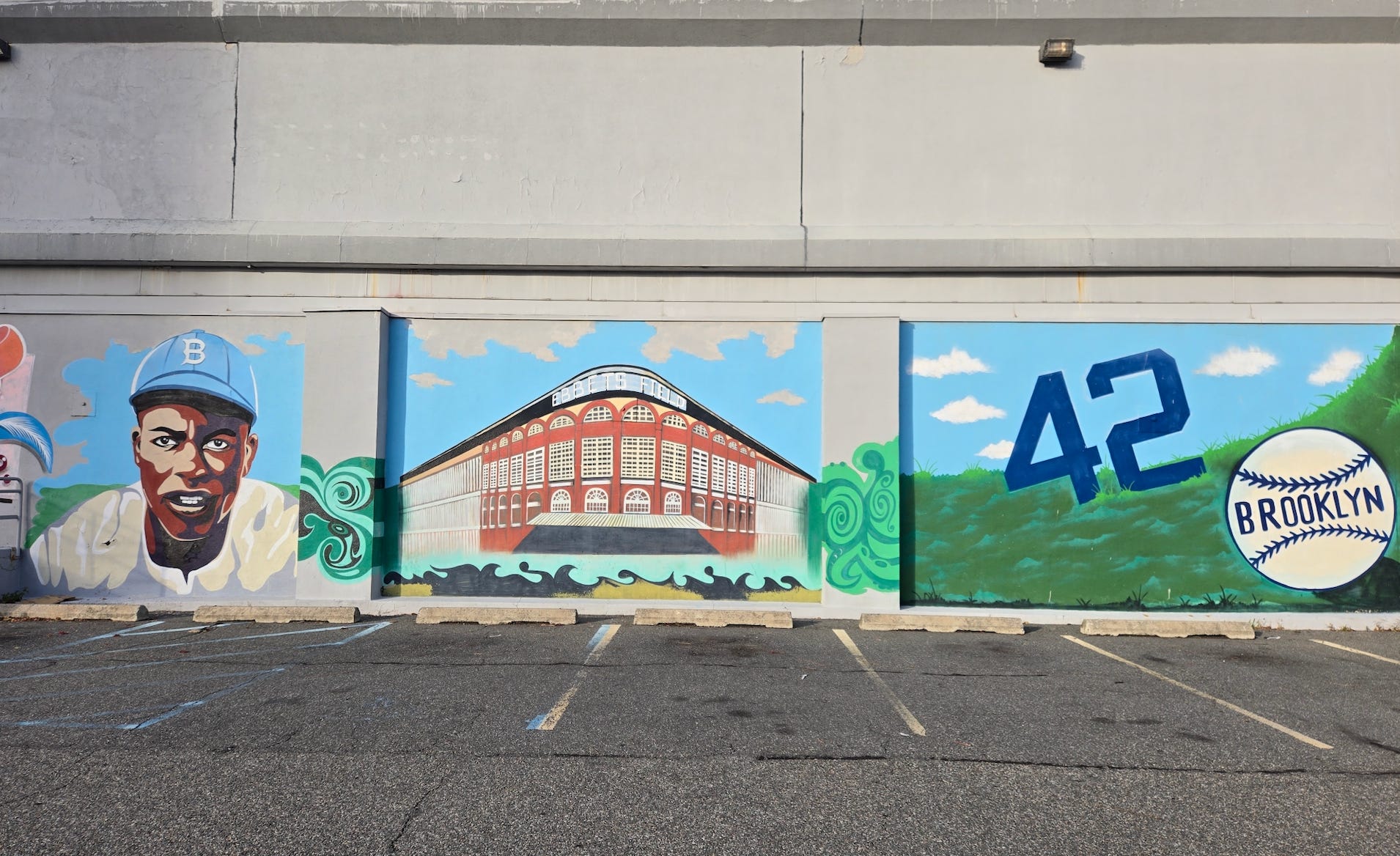
The Brooklyn Dodgers play an especially important role in the history of baseball. It was in Crown Heights, Brooklyn (a part considered Flatbush at the time) where Jackie Robinson made history by breaking the baseball color line in 1947. Robinson and the Dodgers played on another now-demolished baseball stadium, Ebbets Field. It is here that I recommend sports fans make a pilgrimage if they wish to see a part of baseball history. The stadium is now an apartment complex, but around the area are murals, a few commemorative sites and objects, and even a marker for the original home plate in honor of Jackie Robinson. A flagpole from center field is also on public display at Barclays Center, a few subway stops away.
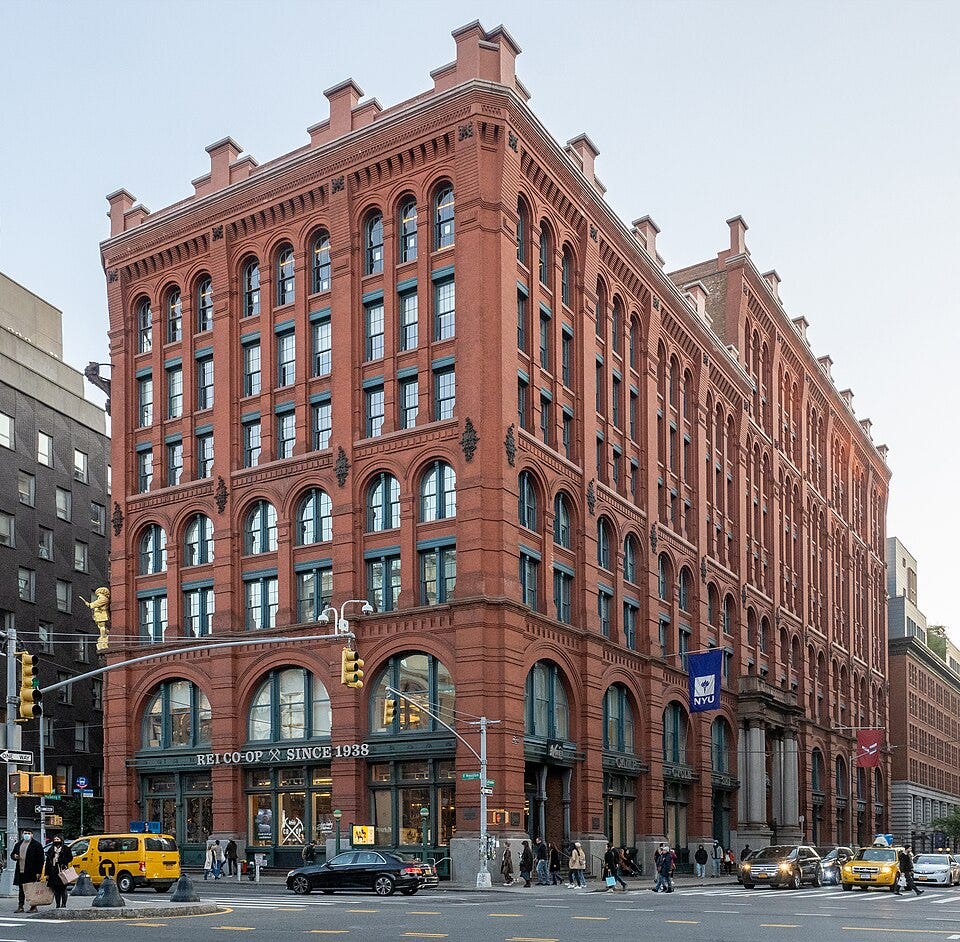
Site 4: Neutral Ground (122 W 26th St)
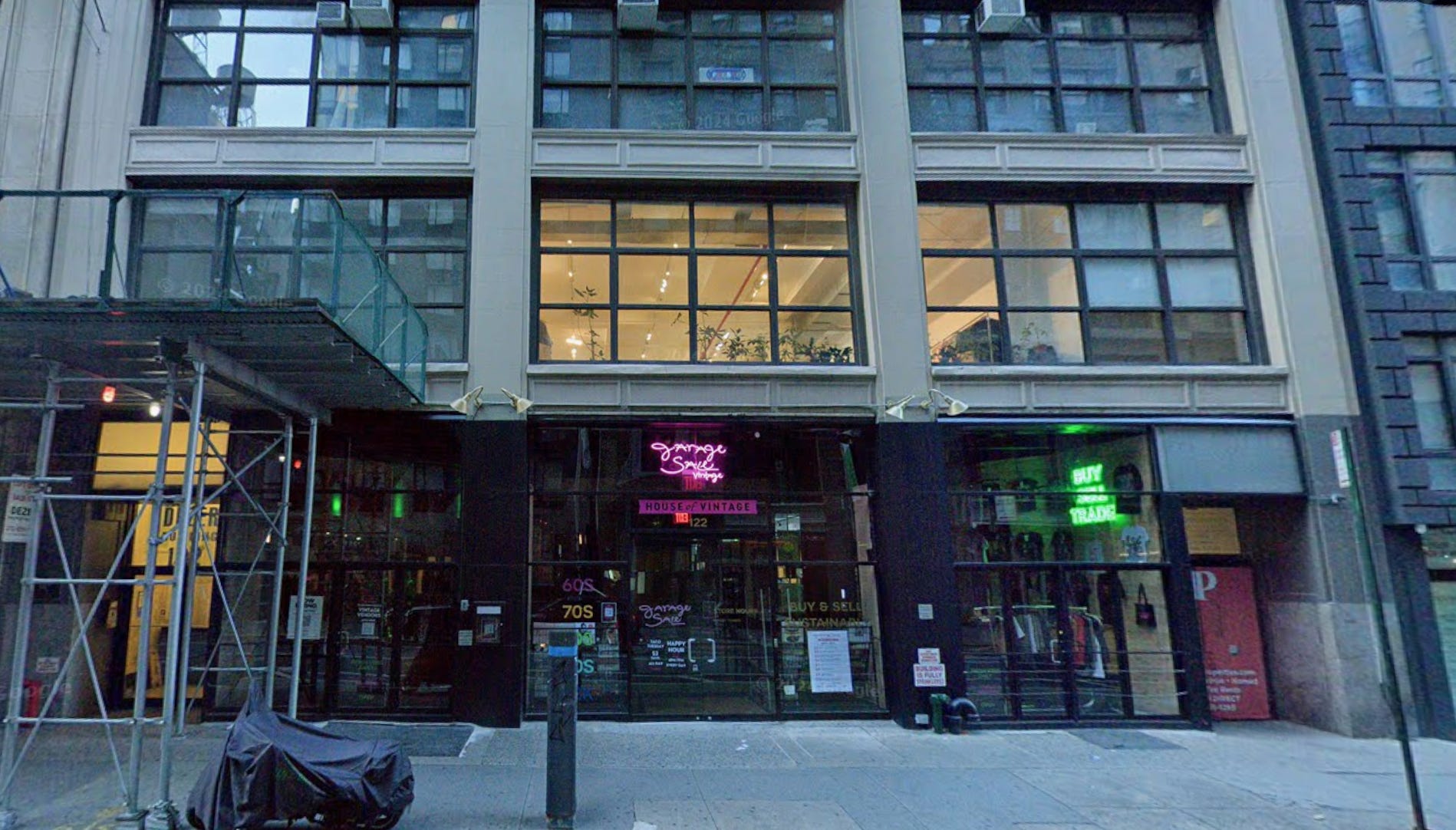
During my most fervent Magic playing years, there were a handful of places to play around the city, a number that has increased into the dozens as of this writing. But this wasn’t always the case. There is one store that for many years was singularly to thank for NYC having a Magic scene at all: Neutral Ground. The original location has, unfortunately, closed down and is currently an event space that doubles as a vintage shop.
But in terms of NYC’s Magic history, its location is borderline sacred. More than bringing Magic to the city, the store, which opened in 1995, “quickly became a nerve center for Magic not just in Manhattan, but the East Coast in general” (Symon, 2022). It was arguably the most famous Magic store in the country and had thousands of square feet of playing space—something hard to come by in Manhattan.
The store also reflects the vast amounts of capital suddenly available to Wizards of the Coast, who were previously accustomed to more modest sales. “The game was a stunning success, a virtual license to print money” (Riggs, 2022). Opening a store in New York City seemed like a natural next step and fundamentally changed where many players went to play the game:
New York City, “Gotham” to some, is the international center of finance, commerce, and anything that has to do with money. Considering the intimate relationship between money and Magic, one may be surprised to learn that for years New York was a mere outpost in the world of Magic, where mages often met only by accident and where rare spells of power were almost unknown. [In 1996] however, New York is in a position to claim a place as one of the major centers of the Magic universe. One of the big reasons for this change is one of the finest gaming arenas in the world: Neutral Ground. (Hahn, 1996)
The one-minute video below gives a sense of what it was like playing in the store a few years after it opened.
This was an early era of Magic. Current players might be surprised to see cards being played without sleeves. The internet existed, but with slow connections and no social media. Former professional Magic player Patrick Chapin recounts what it was like to communicate with his Magic cohorts: “My good friend . . . had just received that era’s equivalent of a text message. A tiny IRC window opened (an odd sort of text message you had to be logged onto your computer to receive), relaying a message by way of a crude sort of Internet connection” (2014).
Despite the space and cost limitations of New York City, it became the nexus for a burgeoning tournament scene. “NYC events,” explains Brian David-Marshall (2005), “were shared among Usenet groups and had an extremely limited number of seats available.” The result was New York City became a necessary pit stop to any Magic player looking to take the game seriously.
David-Marshall was one of the store’s owners and strived to “provide a safe place for these young guys who tend to be really smart but not necessarily slick or very together” (Steinke, 1997). Games at Neutral Ground became the “training grounds of Hall of Famers Zvi Mowshowitz, Steven O’Mahoney-Schwartz, Jon Finkel, and many other notable contemporary players” (Chapin, 2014), turning the store into a virtual theory factory.
.jpg)
Site 5: Puck Building
The ability to dissect Magic like the Neutral Ground players was baked into the game’s original design. Magic was meant to work as a game that could be studied carefully and played with high stakes, along the lines of chess or poker. “All this precision invested in the design of the rules and cards made Magic a surprisingly good game to play seriously,” writes original designer Richard Garfield (2005).
Only a few years into the game’s development, Wizards of the Coast wanted a major, flagship tournament, comparable to the World Chess Championship or basketball’s NBA Finals. The game’s creators encouraged competitive play early on and recognized its potential to attract new players. “I subscribed fully to the concept of a Pro Tour,” writes Garfield (2005). “The NBA helped make basketball popular and didn’t keep the game from being played casually as well.”
Once again, New York City was the logical option. In addition to the Neutral Ground storefront, the city was a convenient hub for much of the country. “In searching for a host city where the excitement could live up to the magnitude of the event, it’s no surprise that Magic’s first Pro Tour was conceived in New York City” (Kornhauser & Holt, 2017). A tournament of this size would not fit in Neutral Ground, however, and required Wizards of Coast to look for a larger space. In 1996, the first Pro Tour took place in Lower Manhattan’s Puck Building, marking another NYC location as pivotal to Magic’s history. In the Pro Tour’s first year, 239 players participated, including winner Michael Loconto, who commuted from Massachusetts.
In addition to the Pro Tour, more casual events became common around the city, and Wizards of the Coast regularly rented space for events that would have stretched the limits of what Neutral Ground could accommodate. New Magic sets are premiered now with casual “pre-release” tournaments that give players an early first look at the cards. The first pre-release, called “The Gathering 1,” was for the 1995 Homelands set, spanned two floors of an NYC hotel, and included side events and artist booths. (Schvartzman, 2004)
Tournaments on a smaller scale continued to happen at Neutral Ground and paid out cash prizes. In the pre-social media days, the Magic decks that people tried out at that store influenced the decks that people played around the world. “The store’s constant high level of competition,” writes Patrick Chapin, “produced many strong decks with rogue origins” (2014). The store’s influence extends to how people organized tournaments everywhere. “Neutral Ground . . . helped standardize the matches to how we know them today” (Symon, 2022).
The game’s first major tournament had the effect of leaving behind a dedicated and connected player base after the tournament ended and entrants returned home. “I think the first Pro Tour in New York really legitimized the New York Magic scene,” reflects pro player Steve O’Mahoney-Schwartz. “After the first Pro Tour, we started to realize you needed to develop a team of people around you who was serious about playing Magic, serious about testing” (Kornhauser & Holt, 2017).
Neutral Ground’s heyday was over by the early 2000s when it changed ownership, and it ultimately closed in 2008. By this time, tournaments were held in places with more space, and game shops around the country stocked Magic cards. Neutral Ground had served its purpose of connecting serious players around the globe, and the store itself was no longer financially viable. One Magic forum user laments in 2009:
Are you guys telling me that Manhattan, the heart of New York City, the biggest and arguably most cosmopolitan city in the United States, the country that is the birthplace of MTG, is devoid of any MTG stores? My mind is boggled. How did this situation come to happen, that even small towns in Middle America and cities on the other side of the world have more MTG than NYC? (TempoTempo, 2009)
Neutral Ground left behind a legacy that represents a specific place and time, but the game grew. A few years after Neutral Ground’s closing, Magic became easy enough to find again in the city. Twenty Sided opened in Brooklyn in 2011, becoming the “hallmark destination for Brooklyn’s Magic scene” (Dillard, 2016). There are now stores with Magic events in every borough. Here are a few that, as of this writing, include MTG in their event calendars:
The Uncommons (East Village, Manhattan)
Montasy Comics (Midtown, Manhattan)
The Compleat Strategiest (Midtown, Manhattan)
Twenty Sided (Williamsburg, Brooklyn)
Hex&Co. (multiple locations)
Sip & Play (Park Slope, Brooklyn)
Gamestoria (Astoria, Queens)
Anyone Comics (Crown Heights, Brooklyn)
Site 6: 30 Rock (30 Rockefeller Plaza)
This past October, a new Magic: The Gathering card was revealed: “Heroes in a Half Shell.” It features the four Teenage Mutant Ninja Turtles, veering wildly outside the Magic “multiverse” canon and into New York City’s subway system. Some fans weren’t happy about mixing the fantasy worlds so freely: “NYC already thinks it’s the center of the world, now it’s the center of the multiverse!” (Scottv2, 2025)
While I can’t speak for what NYC “thinks,” it’s certainly not the center of the “multiverse,” referring to the fictional planes in which the canonical stories of Magic take place. This claim stems from a string of small “Universes Beyond” sets, where Magic cards borrow from other pop culture canons. In 2024 and 2025, Wizards of the Coast published cards that inhabited the universes of Ghostbusters, Spider-Man, and as I mentioned, the Teenage Mutant Ninja Turtles, all of which take place in New York City. (“Universes Beyond” also included—and continues to include—dozens of non-NYC universes.) However, for most of the game’s history, the city was barely represented in the game’s lore at all.
This is, to be clear, in no way a given. Outside of Magic, New York City can be found across many games. Tammany Hall is a well-known board game set among the corrupt political power in the era of Boss Tweed, and Ticket to Ride and Age of Steam both have NYC-specific versions. A comprehensive list of video games that take place in NYC is staggering, which includes the 1983 Mario Bros. arcade game that is set in the city’s sewers. Grand Theft Auto or any game involving Batman show that fictional cities can be clearly NYC-inspired, not to mention the countless other games that involve the worlds of King Kong, Futurama, Men in Black, and so on.
Apart from “Universes Beyond,” Magic takes place in a variety of fantasy settings that aren’t on Earth, let alone in New York City. Yet the settings are still often based on real cultural locales around the world. Andrei Zanescu, who wrote a doctoral thesis on the topic (2023) lists some examples: “the Middle East (Arabian Nights, 1993), Japan (Kamigawa, 2004; 2022), India (Kaladesh, 2016) [. . .] Ancient Egypt (Amonkhet, 2017) and Archaic Greece (Theros, 2013, 2014, 2014, 2020).”
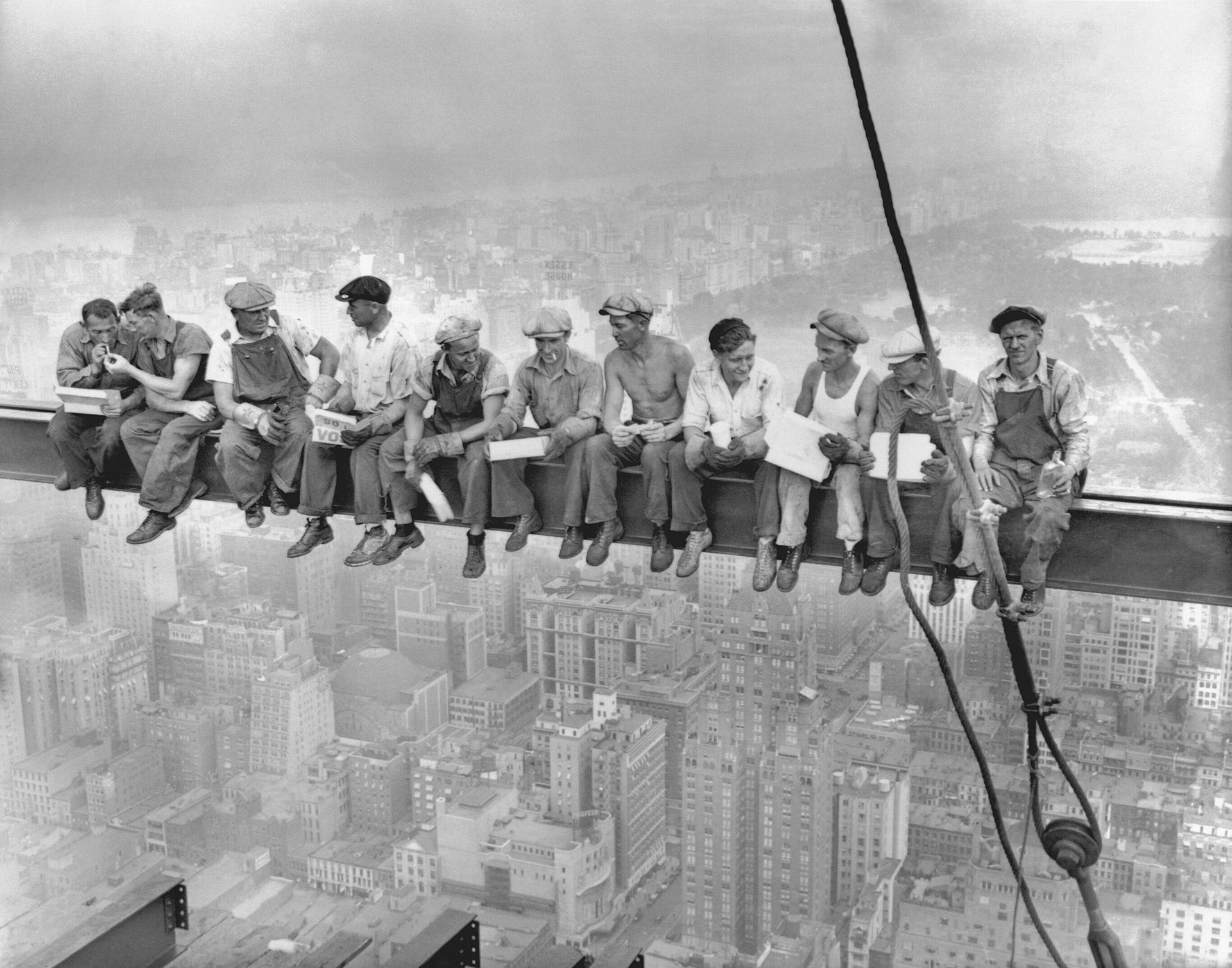
A canonical location being modeled after NYC didn’t truly occur until 2022 with a card set titled Streets of New Capenna, which was designed after urban gangster movies. One card in particular, “Riveteers Ascendancy,” makes an unambiguous city reference. “Back in 1932, a famous black and white photograph was taken that showcased 11 construction workers eating on top of a construction beam high up above New York City,” writes Jerrad Wyche (2022). “Riveteers Ascendency is a multi-color enchantment in Streets of New Capenna that’s practically a one-for-one copy of that iconic photograph. It is likely meant to evoke [pride for blue-collar workers] in the world of MTG.”
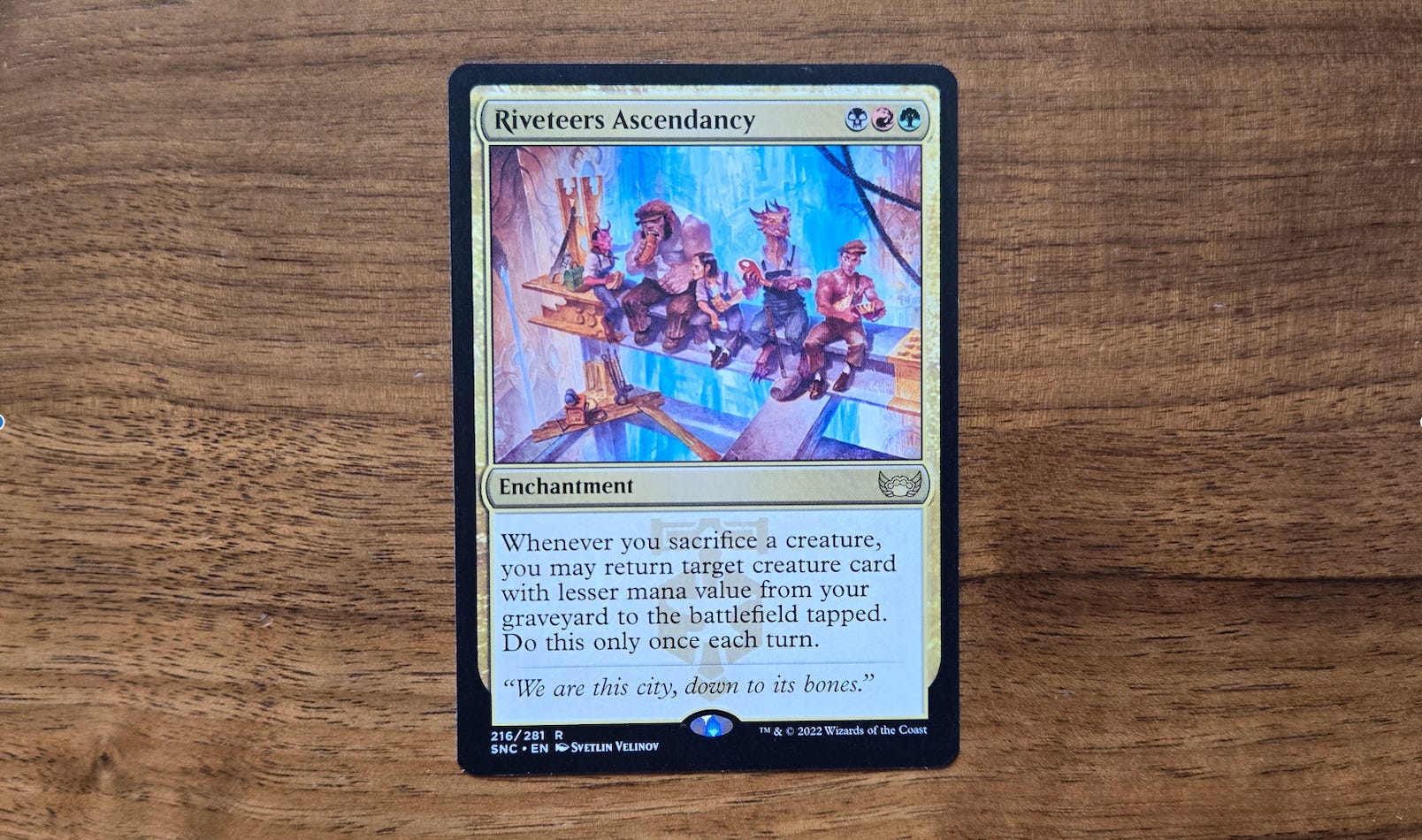
The photo came from a series of photographs done for publicity, clarifies Time in one video (Cauláin, 2016). The construction workers didn’t typically eat while dangling for their lives. But their work is unquestionably death-defying, and even the bravery to take the photo is obvious. (Less immediately obvious is the bravery of the photographer.) Perhaps there’s a parallel too between this magical game that created a fortune upon the fledgling company Wizards of the Coast and this magical building of Rockefeller Center that created a fortune’s worth of “economic opportunity for a population struggling through the Great Depression” (Hudes & The Center Magazine Staff, 2023).
Given that image’s unique history within the history of Magic card art, I selected 30 Rock as a site to visit, but since the Universes Beyond sets, the options have grown, although the Magic connection becomes more tenuous:
The Firehouse, Hook & Ladder Company 8 fire station in Tribeca is famous for its appearance in Ghostbusters.
There is a Teenage Mutant Ninja Turtles manhole cover near the reptile house at the Bronx Zoo.
The campuses, exhibitions, and events of Columbia University, which is mostly in Morningside Heights, or NYU, which is basically everywhere but concentrated in Lower Manhattan, are collectively the inspiration for Empire State University, the fictional college that Peter Parker attends (when not moonlighting as Spider-Man).
A Magical Community
In preparing this article, at times I felt like I was excavating recesses of the internet trying to find Magic history. Thank the almighty Wizards of the Coast for digitally archiving all issues of the Duelist, a magazine dedicated to trading card games printed throughout the 90s. Sometimes I was also achingly reminded of what happens when you let teenagers loose on the internet. I was thrust back to Crackgate in 2014, where a Magic tournament attendee gained internet notoriety for photographing himself alongside visible butt cracks of unsuspecting players.
Complicated games with cards and dice attract a lot of nerdy gamers. I say that from experience and with love. Nerds are great. I was (am?) definitely one. I’d argue that people who put careful thought into improving their Magic play are, whether they like it or not, learning how to improve in virtually anything. Children who play the game can find complex problems that they’re motivated to solve. Adults who play the game can find a community outside work and family.
Sadly, some Magic playing spaces coalesce into insider clubs high on testosterone, low on hygiene, and where everyone can somehow afford loose packs of cards. Ethnographers studying toxic masculinity describe a board game café that hosted Magic events in 2021 (Falcão, Macedo, & Kurtz): “This space . . . was often frequented by women, but they rarely developed any relation with Magic. It was as if this store held two distinct universes in the same communal space: in one, people ate, drank, and had fun; in the other, the energy was heavy and conflict was palpable.” The decades-old video of Neutral Ground earlier in the post is fascinating to watch, but the demographics aren’t lost on me.
The designers of Magic deserve credit for their efforts at inclusivity and have published cards and official canon featuring characters of different races, genders, and sexual orientations. They have also looked to right past wrongs. In 2020, cards with problematic art and themes that were printed in the 90s were no longer allowed to be played. “When the Black Lives Matter movement was again making institutional racism visible, Wizards of the Coast . . . banned seven cards with ‘racist or culturally offensive’ images in all sanctioned tournament play” (Stenros & Montola, 2024). Stores in NYC are usually quick to nip sexism, racism, and transphobia in the bud, and I can attest to great community that can be found among this city’s Magic players.
I want to end this article on a positive note, however. A Magic card is just a small piece of cardboard, but despite its West Coast origins, it is also a relic of NYC history when you look closely enough. Hidden behind it are Medieval-era card collectors, revolutionary baseball players, and nerdy kids who went on to become icons in gaming history. In my time playing Magic in this city, I’ve come across some of the kindest, smartest people I’ve ever met. And for those few years where I belonged to a playgroup filled with neighbors, friends, and like-minded geeks around the city, I felt like part of a community that was simply magical.
Works Cited
Brass, Molly, and Stephen Tyler, dirs. 2018. The Last Chess Shop in New York City. Produced by The Atlantic, Molly Brass, Stephen Tyler, Anne Hollowday, and Fisayo Olajide. Lonelyleap. 06:55. https://www.youtube.com/watch?v=eh8U6SLvNgs.
Brougère, Gilles. 2004. “How Much Is a Pokémon Worth? Pokémon in France.” In Pikachu’s Global Adventure: The Rise and Fall of Pokémon, edited by Joseph Tobin. Duke University Press.
Cauláin, Éamonn Ó, dir. 2016. Lunch Atop A Skyscraper: The Story Behind The 1932 Photo. Produced by Kira Pollack, Paul Moakley, Tara Johnson, Red Border Films, and Time. 100 Photos. Time Inc. https://www.youtube.com/watch?v=7QCYDzsQ_yM.
Chapin, Patrick. 2014. Next Level Deckbuilding: The Ultimate Magic: The Gathering Deckbuilding Resource. Next Level Unlimited.
David-Marshall, Brian. 2005. “Saviors of Kamigawa Prerelease Primer.” MagicTheGathering.Com > Columns, May 16. http://www.wizards.com/default.asp?x=mtgcom%2Ffeature%2F265.
Dillard, Todd. 2016. “The Phases: Love, Loss, and Magic the Gathering.” Literary Nonprofit. Electric Literature, July 20. https://electricliterature.com/the-phases-love-loss-and-magic-the-gathering/.
Falcão, Thiago, Tarcizio Macedo, and Gabriela Kurtz. 2021. “Conservadorismo e Masculinidade Tóxica Na Cultura Gamer: Uma Aproximação a Magic: The Gathering.” MATRIZes 15 (2): 251–77. https://doi.org/10.11606/issn.1982-8160.v15i2p251-277.
Fenton, Greg. 2015. “Reviewing the Art of Alpha.” Vintage Magic, November 2. https://www.vintagemagic.com/blog/greg-fenton-reviewing-the-art-of-alpha/.
Garfield, Richard. 2005. “The Design Evolution of Magic: The Gathering.” In The Game Design Reader: A Rules of Play Anthology, edited by Katie Salen Tekinbas and Eric Zimmerman. The MIT Press.
Goldstein, Richard. 2014. “Sy Berger, Who Turned Baseball Heroes Into Brilliant Rectangles, Dies at 91.” A. The New York Times (New York, NY), December 15.
Hahn, Rob. 1996. “Spotlight On: Neutral Ground.” The Duelist, September.
Huberman, Andrew. 2025. Josh Waitzkin: The Art of Learning & Living Life. Episode 213. Huberman Lab. January 27.
Hudes, Karen and The Center Magazine Staff. 2023. “The History of the ‘Lunch Atop a Skyscraper’ Photo at Rockefeller Center.” The Center Magazine, November 21. https://www.rockefellercenter.com/magazine/arts-culture/lunch-atop-skyscraper-irish-immigrants/.
Jamieson, Dave. 2010. Mint Condition: How Baseball Cards Became an American Obsession. Atlantic Monthly Press.
Kornhauser, Shawn, and Nathan Holt, dirs. 2017. Enter the Battlefield: Neutral Ground. Produced by Greg Collins and Wizards of the Coast. https://www.youtube.com/watch?v=4XKeNWiqFws.
Professional Sports Authenticator [PSA]. 2025. “1952 Topps Mickey Mantle.” PSA Cardfacts. www.psacard.com/cardfacts/baseball-cards/1952-topps/mickey-mantle-311/23330.
Randhawa, Manny. 2022. “Honus Wagner T206 Card Sells for Record $7.25 Million.” MLB.com, August 4. https://www.mlb.com/news/rare-t206-honus-wagner-baseball-card-sold-for-7-25-million.
Riggs, Ben. 2022. Slaying the Dragon: A Secret History of Dungeons & Dragons. St. Martin’s Press.
Roeder, Oliver. 2022. Seven Games: A Human History. W.W. Norton & Company.
Rosenberg, Adam. 2017. “Dana Fischer Is an Amazing (and Adorable) 6-Year-Old ‘Magic’ Pro.” Entertainment. Mashable, July 10. https://mashable.com/article/magic-gathering-dana-fischer-6-year-old.
Scottyv2. 2025. “You know it’s rough when even Jim Davis can’t do it anymore.” r/magicTCG, October 11. https://www.reddit.com/r/magicTCG/comments/1o3zjqg/you_know_its_rough_when_even_jim_davis_cant_do_it/.
Shvartsman, Alex. 2004. “GP Madrid in the Books.” MagicTheGathering.Com > Columns, February 26. http://wizards.com/default.asp?x=mtgcom%2Fdaily%2Fash3.
Steinke, Darcey. 1997. “Masters of Their Domain.” Spin, August.
Stenros, Jaakko, and Markus Montola. 2024. The Rule Book: The Building Blocks of Games. Playful Thinking. The MIT Press. https://doi.org/10.7551/mitpress/14730.001.0001.
Symon, Evan. 2022. “Remembering Neutral Ground: One of the Most Important Magic Stores in MTG History.” Magic Untapped, October 3. https://magicuntapped.com/index.php/articles/remembering-neutral-ground-one-of-the-most-important-magic-stores-in-mtg-history.
TempoTempo. 2009. “Magic in NYC.” MTG Salvation, April 2. https://www.mtgsalvation.com/forums/magic-fundamentals/magic-general/319287-magic-in-nyc.
The Met [The Metropolitan Museum of Art]. 2016. “The Cloisters Playing Cards.” The Met. https://www.metmuseum.org/art/collection/search/475513.
The Uncommons. 2025. “The Uncommons.” The Uncommons [Homepage]. https://uncommonsnyc.com/. Accessed November 9, 2025.
Wilkinson, W. H. 1895. “Chinese Origin of Playing Cards.” American Anthropologist 8 (1): 61–78.
Wyche, Jerrad. 2022. “8 Pop Culture References You Missed in MTG’s Streets of New Capenna.” The Gamer, May 3. https://www.thegamer.com/magic-the-gathering-mtg-streets-of-new-capenna-pop-culture-references/.
Zanescu, Andrei. 2023. “Blockbuster Resonance in Games: How Assassin’s Creed and Magic: The Gathering Simulate Classical Antiquity.” Doctor of Philosophy, Concordia University.
Zupke, Andy. 2024. “First Look at the Marvel and Magic: The Gathering Crossover at NYCC.” Commander’s Herald, September 20. https://commandersherald.com/first-look-at-the-marvel-and-magic-the-gathering-crossover-at-nycc/.